JOURNAL
Kingdom of Lo and the Year of the Fire Horse
•
Lisa Kristine
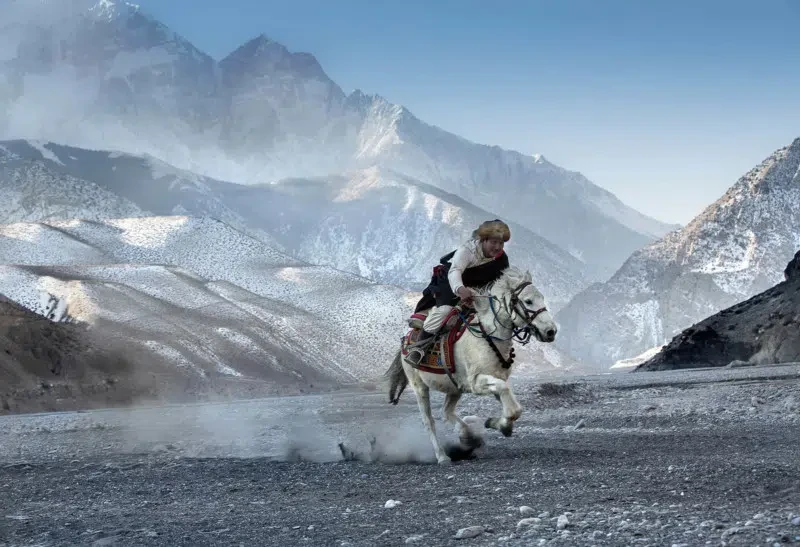
In the high desert of the Himalayas, where wind shapes the land into ancient sculptures and silence feels sacred, I witnessed a moment that seemed to transcend time. An equestrian rode across the vast valley of the Kingdom of Lo in Mustang, his powerful stallion cutting through snow and wind with unwavering strength. It was a scene alive with motion and meaning, luminous in its quiet intensity.
A Landscape of Power and Poetry
In the remote region of Mustang, once known as the Kingdom of Lo, the land itself feels mythic. Towering mountains rise like colossal guardians. Snow churns under hoof. The wind sweeps across the valley in rhythmic gusts that echo through the cliffs and canyons.
Here, I watched a Tibetan horseman astride his sturdy steed. The pair moved with obvious vigor, their breath visible in the cold air. Sunlight struck the snow with vivid, reflective brilliance, casting deep purple hued shadows across the textured earth. The mountains behind them formed gigantic, contributing sculptures, shaping the backdrop into something both elemental and divine.
In that fleeting moment, I was captivated by their dynamic journey. It felt symbolic of something greater, a testament to resilience etched into both land and spirit.
The Year of the Fire Horse: Resilience in Motion
As the 2026 Lunar New Year begins in mid February, the Chinese zodiac calendar marks it as the Year of the Fire Horse. Across Asia and throughout the United States, where I live, communities gather to celebrate with festivals, parades, symbolic foods, fireworks, and cherished rituals.
According to the zodiac, the horse represents hard work, bravery, and steadfast resilience. The Fire element intensifies these qualities with passion, vitality, and bold energy. Watching the Tibetan horseman in Mustang, I saw these attributes embodied in real time. His posture was steady, his focus unwavering. The stallion’s muscular grace spoke of strength earned through endurance.
It was as though the landscape itself honored the spirit of the horse.
Within Lisa Kristine Photography, moments like this reflect the heart of Humanitarian Photography and Social Impact Storytelling. They are reminders that cultural symbolism is not abstract. It lives and breathes through people, traditions, and daily acts of courage.
Losar: A Time of Reflection and Renewal
In Tibet, Nepal, and neighboring Himalayan regions, the 15 day Lunar New Year festival is known as Losar. It is a sacred time of reflection, spiritual purification, and ritual offerings that honor the Buddha and other divine beings.
Losar is more than celebration. It is a reaffirmation of community and shared humanity.
Families gather for shared meals. Homes are cleansed and adorned. Prayer flags flutter against snowy peaks, carrying hopes and blessings into the wind. Monasteries resonate with chants that feel both ancient and immediate.
A vital component of Losar is the strengthening of community bonds. Through collective rituals and cultural traditions, individuals reconnect not only with one another but with something deeper. A luminous thread of continuity that binds past, present, and future.
In witnessing these traditions, I am reminded that Cultural Diversity is one of our greatest treasures. Each ceremony, each gesture of reverence, carries the weight of generations and the promise of renewal.
Human Dignity and Hope in the High Himalayas
The Tibetan horseman in Mustang is not simply a striking image. He represents the enduring spirit of people who live in harmony with a formidable landscape. His partnership with his horse reflects trust, mutual reliance, and quiet strength.
This is the essence of Transformative Portraiture and Compassion Driven Storytelling. It is about honoring Human Dignity and Hope in every frame.
Through Lisa Kristine Art and my Global Humanitarian Projects, I seek to illuminate these stories with reverence and authenticity. Ethical Photography requires patience, presence, and deep respect. It asks us to see beyond spectacle and into the soul of a moment.
In Mustang, beneath the sweeping sky and sculpted peaks, I felt a profound sense of our shared humanity. The horseman’s journey across the valley mirrored our own collective path. We all move forward through uncertain terrain. We all rely on courage, resilience, and community.
A Broader Reflection on Global Cultures and Traditions
The Year of the Fire Horse and the celebration of Losar remind us that traditions are not relics of the past. They are living expressions of identity and belonging. In a rapidly changing world, they anchor us.
Humanitarian Photography plays a vital role in fostering Cross Cultural Understanding. By witnessing and honoring Global Cultures and Traditions, we nurture empathy in art and inspire meaningful global connection.
When we truly see one another, we expand the boundaries of compassion.
In the luminous snowfields of the Kingdom of Lo, I was reminded that strength is not loud. It is steady. It endures. And it carries us forward with grace.
A Call to Hope and Action
As we enter the Year of the Fire Horse, may we embody its spirit. May we work diligently, stand bravely, and uplift one another through compassion and shared purpose.
Let us honor the resilience of communities in Mustang and across the globe by committing ourselves to awareness, respect, and meaningful engagement.
How You Can Support
Learn About Losar and Himalayan Traditions: Deepen your understanding of Global Cultures and Traditions to foster Cross Cultural Understanding.
Support Ethical Photography and Social Impact Storytelling: Explore Lisa Kristine Photography and Lisa Kristine Art to see how imagery can elevate Human Dignity and Hope.
Share Stories of Resilience: Amplify Awareness Campaigns and Fine Art Documentaries that highlight Indigenous Communities and Global Humanitarian Projects.
Celebrate Cultural Diversity: Participate in local Lunar New Year events and reflect on the transformative power of community.
May this new year ignite a fire within us all, one that honors bravery, compassion, and the luminous dignity that connects us across continents and cultures.